
When mental health support and school support feel like two separate worlds, and you’re the only one connecting them
You’re sitting in another meeting. The guidance counselor mentions something your child’s therapist recommended three weeks ago, but they’re interpreting it differently than you understood it. The IEP coordinator hasn’t seen the testing report yet. The teacher didn’t know about the medication change. And you realize, once again, that you’re the only person in the room who has the full picture.
You’re not imagining it. School systems and mental health systems don’t naturally talk to each other. And somehow, you’ve become the translator, the coordinator, and the keeper of all the information.
It’s exhausting. And I think it’s one of the most underestimated challenges parents face when supporting a child’s mental health.
A Quick Note Before We Begin
The intersection of mental health support and school accommodations is complex and varies significantly by state, district, and even individual schools. Special education laws, IEP processes, 504 plan implementation, and available resources all differ depending on where you live.
This post covers general principles that apply broadly, but it can’t address every state-specific rule or process. If you’re navigating IEPs, 504 plans, or school-based mental health support, I strongly encourage you to connect with resources in your state or district that can help you understand what’s available where you live and how the system works in your specific district.
Quick Answer
To organize school and mental health information for your child, keep a communication log of all conversations, maintain a contact list of providers and school staff, save testing reports and formal documentation in one place, take your own notes at IEP meetings, and track what you’re waiting for from both systems. Having all critical information in one central location, whether a binder or digital folder, helps you advocate effectively.
Why These Two Worlds Don’t Connect (But Need To)
Here’s the reality: schools and mental health providers operate in completely different systems with different rules, different timelines, and different languages.
Mental health providers offer clinical treatment. They diagnose, provide therapy, prescribe medication, and help your child develop coping strategies. But their work happens outside of school, usually in weekly or monthly appointments.
Schools provide the environment where your child spends most of their day. Public schools are required to provide a free and appropriate education. When a child’s mental health impacts their ability to learn, it may qualify as a disability under special education law, which means the school has a legal obligation to provide support. However, schools don’t specialize in mental health treatment. While many schools and districts have counselors, most public schools don’t have the resources to provide the level of clinical or therapeutic support some children need, and those resources vary dramatically from district to district and state to state.
When mental health challenges affect a child’s ability to learn, participate, or feel safe at school, support might look like:
- Accommodations (extra time on tests, breaks when needed, modified assignments)
- An IEP (Individualized Education Program) or 504 Plan that formally documents what support the school will provide
- Access to school counselors, psychologists, or other support staff
- Modified schedules or alternative learning environments when traditional classroom settings aren’t working
It’s important to note that a diagnosis alone is not sufficient to qualify for school-based services. Schools need to see how the mental health condition specifically impacts learning.
Here’s the problem: Your child’s therapist can’t implement accommodations at school. The school can’t provide clinical therapy. Each system does something the other can’t, but neither one automatically knows what the other is doing.
Testing creates another gap. Schools often need formal testing, official diagnoses, and concrete evidence of how a child’s mental health impacts their ability to learn before they can provide accommodations. But testing can take weeks or months to schedule. It can cost thousands of dollars if you go through a private psychologist. And even if you get testing done independently, the school may require its own evaluation before moving forward.
During all that waiting, your child is still struggling. And you’re caught in a system that moves far slower than the urgency you feel.
That’s where you come in. You become the bridge. You’re translating the therapist’s clinical recommendations into language the school can act on. You’re explaining to providers what’s happening at school so they can adjust treatment. You’re making sure testing results get to the right people. You’re keeping everyone informed about medication changes, crisis moments, and progress.
It’s a lot. And it’s why getting organized makes such a difference.
If you’re wondering why managing your child’s mental health already feels overwhelming, coordinating with schools adds another layer of complexity.
What It’s Like in the Gap
Some families wait months before an IEP is in place or before the right accommodations are identified. During that time, there’s not much you can do except keep communicating.
You email the school with updates. You follow up to see if there’s any movement. You try to manage things at home while encouraging your child to stay engaged with school, even when that feels like an uphill battle.
It often feels like you’re the only one who’s desperate to figure this out. Schools are working with dozens, if not hundreds, of students and families. Providers have full caseloads. No one and no system moves as quickly as you need it to.
The only thing you can control is communication. So you keep showing up. You build relationships with the school team. You approach it as a collaboration, hoping that if everyone works together, you can find a path forward.
But when a child is struggling to attend school or fully engage with school, when anxiety or depression or other challenges make a regular school day feel impossible, you need concrete solutions. And if you don’t know what accommodations or support are even possible, it’s hard to ask for them.
Before You Know What to Ask For
In the early stages, many parents describe what’s wrong in broad terms:
- “My child is really struggling.”
- “They can’t handle a full school day.”
- “We need help, but we don’t know what kind.”
Those statements are true. But they’re not specific enough for a school to act on.
Schools and parents need to work together to identify concrete requests: specific accommodations, clear plans, and measurable supports. But if you’ve never navigated an IEP or 504 before, if you don’t know what’s even allowed or possible, how are you supposed to know what to ask for?
This is where the language gap becomes critical. A therapist might say, “Your child needs breaks when they’re feeling anxious.” But what does that look like in practice?
- An anxiety pass to visit a specific teacher or counselor when needed?
- Seating in the back of the classroom so they don’t feel like everyone is watching them?
- The ability to step out of class without asking permission?
- Additional time to complete assignments?
These are the kinds of specific school accommodations that can actually be written into an IEP or 504 plan. But many parents don’t know these are options until someone who understands both the clinical need and the school system explains them.
What Actually Needs to Be Organized
What school and mental health records should I keep?
Here’s what makes this coordination so overwhelming: You’re managing information from multiple systems that don’t talk to each other.
When you’re navigating both school accommodations and mental health treatment, you may be juggling:
- Testing reports and diagnoses from psychologists or psychiatrists, which the school will ask for repeatedly
- Email threads with teachers, counselors, administrators, and case managers
- Meeting minutes from IEP or 504 meetings, official records of what was decided
- Your own notes from those same meetings. What was actually said, what you heard, what you need to follow up on
- Action items and to-do lists, including what you’re responsible for, what the school committed to, and what providers need to send
- Recommendations from therapists and doctors, often given verbally and not always written down
- Mental health records, including updates on medication or treatment changes, which the school may need to know about
All of these pieces live in different places: emails, voicemails, paper handouts from meetings, and notes scribbled during phone calls. And when you need to reference something, when the school asks “did the psychologist recommend X?” or when you’re trying to remember what the counselor said three weeks ago, you’re digging through everything trying to find it.
(This is a lot! See my post on Why does managing my child’s mental health feel like a full-time job.)
If both parents or caregivers are involved, it helped us immensely to have both people attend meetings. That way, you’re both hearing the same information, you can ask questions together, and you can check in with each other afterward about what was said.
What Information Should I Track for My Child’s School Support/ Accommodations and Mental Health Treatment?
If you’re feeling overwhelmed by all the moving pieces, here’s what matters most:
1. Keep a running communication log
Every time you email, call, or meet with someone (school staff, therapist, psychiatrist), jot down:
- Date
- Who you spoke with
- Key points discussed
- What was decided or recommended
- What you need to follow up on
You don’t need paragraphs. Even bullet points like “3/15 – called school counselor – discussed anxiety pass – she’ll talk to teacher and get back to me by Friday” is enough.
2. Create a simple contact list
In one place, write down:
- Names and roles of everyone involved (teacher, counselor, IEP coordinator, therapist, psychiatrist, advocate)
- Phone numbers and emails
- Best way to reach them
- Their office hours or response times
When you need to reach someone quickly, you won’t waste time hunting for their information.
3. Save testing reports and formal documentation
Any official reports, psychological evaluations, diagnoses, medical records, keep them together. Having them in one place (even a folder or large envelope) means you’re not searching every time they are needed.
4. Take your own notes in meetings
Even if the school sends official meeting minutes later, take your own notes during IEP or 504 meetings:
- What was discussed
- What you heard them commit to
- Questions you still have
- Your own observations
Your notes might capture things the official minutes don’t, and later, when you’re trying to remember what was actually said, you’ll be grateful you wrote it down.
5. Track what you’re waiting for (this may be covered in your communication log)
Keep a running list of:
- What you’re waiting on from the school (testing results, meeting schedules, accommodation updates)
- What you’re waiting on from providers (reports, recommendations, prescription updates)
- What you need to do (send documents, follow up, schedule appointments)
This keeps things from falling through the cracks when life gets chaotic.
What’s the Best Way to Organize School and Therapy Information?
You don’t need a perfect system. You don’t need color-coded binders and detailed spreadsheets (unless that’s your style, then go for it).
What you need is one place where the critical information lives.
That could be:
- A simple 3-ring binder with divider tabs (this is what worked best for me, so I could carry it to each meeting and have it at my fingertips when I needed it)
- A notebook where you write everything chronologically
- A folder on your computer with subfolders for each category
- Even a dedicated email folder where you save and summarize key threads
The format matters less than the fact that when you need something, you know exactly where to look.
When everything is in one place, you stop searching. You stop second-guessing whether you remembered something correctly. And when you walk into a meeting or call an advocate or email a teacher, you have what you need right in front of you.
That one shift, from scattered information to organized information, doesn’t solve the systemic challenges. But it gives you back a sense of control when so much feels out of your hands.
Getting organized helps you communicate clearly and advocate effectively. But sometimes, even with good organization, you need someone who knows how the system works to help you navigate it.
Finding Support When Organization is Not Enough
For some families, including ours, the turning point comes when they bring in outside help. Someone who knows what schools can and cannot do, understands the local resources and policies, and can ask for specific solutions on your behalf.
Not everyone can afford to hire professional help, and that’s okay. There are other ways to get support:
- Parent Training and Information Centers (PTIs) exist in every state and provide free information and support to families navigating special education
- Local parent support groups (often through organizations like NAMI, CHADD, or school district family resource centers) can connect you with other parents who’ve been through this and can share what worked
- School district parent liaisons or family advocates – some districts have staff whose job is to help families navigate the system, you just need to ask your school about those resources
- Your child’s providers may be able to write specific recommendations that you can bring to the school, which can carry weight even without an advocate present
- Searching online can help you find resources like those offered by Understood. Try searching for ‘[your state] special education advocate,’ or ‘IEP advocate in [city/state].’
If you have the resources to hire professional help, this might be an educational advocate or a special education attorney. The terminology varies by location. In some states, “advocate” refers specifically to lawyers, while in others, it describes non-attorney professionals who specialize in navigating IEPs and school accommodations.
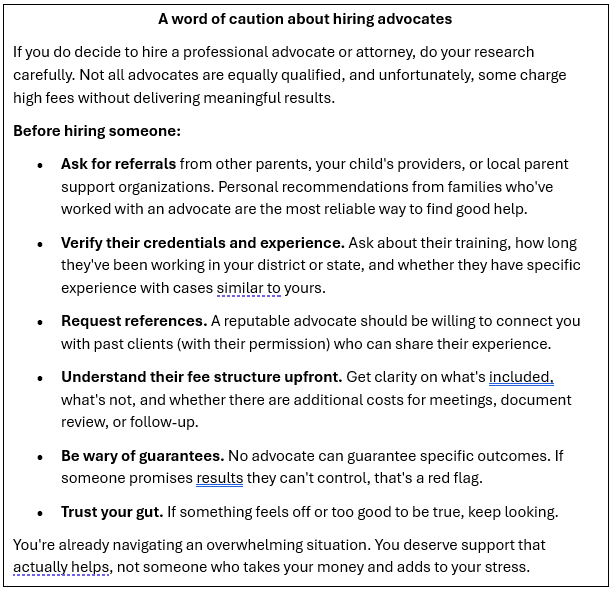
When someone with experience in the school system gets involved, whether that’s a paid advocate, a parent mentor, or a provider who writes detailed recommendations, they can suggest alternatives many parents might never have thought of. In our case, this included:
- A tutor for specific subjects
- Meeting with a teacher at a neutral location like a library
- After-hours sessions at school when the building is quieter and less overwhelming
- A structured transition plan to re-engage gradually
We never would have known that we could have requested these things. And they’re not always things schools volunteer or can implement (it is highly school-dependent). But in many cases, schools are willing to work with families on creative solutions if someone knows to ask.
People with experience in these systems also bring something else that’s invaluable when you’re deep in crisis mode: they can communicate the facts without the emotional weight. They can distill what your child needs, what’s been tried, and what the next steps should be, without the exhaustion and fear that colors every conversation when it’s your own child.
That doesn’t mean your emotions don’t matter. They absolutely do. But when you’re struggling and running on empty, having someone else who can clearly articulate the path forward can be a lifeline, whether that’s a paid professional or a more experienced parent who’s walked this road before you.
Additional resources if you’re trying to figure out what accommodations to request or how to work with your school system:
- NAMI (National Alliance on Mental Illness): Many local chapters offer family support groups and parent mentors
- Council of Parent Attorneys and Advocates (COPAA): Directory of educational advocates and attorneys by state
- Wrightslaw: Extensive free resources on special education law and advocacy
- U.S. Department of Education – IDEA: Information about the Individuals with Disabilities Education Act and your child’s rights
You don’t have to figure this out completely alone, even if hiring professional help isn’t an option right now. I’ll be writing more about navigating school systems and when to consider bringing in professional support in a future post. For now, knowing these resources exist is a good starting point.
You’re Doing Hard Work
Coordinating between school systems and mental health providers is genuinely difficult. These systems weren’t designed to work together seamlessly, and the burden of connecting them falls on you.
If this feels overwhelming, you are not alone and you are not failing. This type of coordination is complicated and slow-moving.
But taking one small step, getting a little more organized, learning what’s possible, finding people who can help you ask for what your child needs, can help to make this easier.
You’re already showing up. You’re already advocating. And that effort counts, even when progress feels impossibly slow.
– Laurie
Ready to get organized?
The Overwhelmed to Organized guide includes ready-to-use templates for communication logs, contact lists, and a complete parent binder setup so you don’t have to create a system from scratch. The principles above will work no matter what system you choose, but if you want a structured approach that’s already designed for you, the guide walks you through exactly how to set it up.
Learn more about the Overwhelmed to Organized guide
This is Week 5 in a series about the real challenges parents face when supporting children through mental health struggles.
Week 1 explored feeling overwhelmed and not knowing where to start.
Week 2 addressed why managing your child’s mental health feels like a full time job.
Week 3 talked about why managing your child’s mental health feels different from everything else you’ve organized.
Week 4 talked about what information parents should track for their child’s mental health.